
Technical Papers
Explore peer-reviewed publications, conference papers, laboratory studies, and technical bulletins that demonstrate the science behind our technologies. These resources highlight decades of research on substrate performance, bioaugmentation, nutrient optimization, nitrate mitigation, ZVI applications, and other proven approaches that help environmental professionals design more effective in-situ remediation solutions.
Below are a list of technical papers, which demonstrate:
The distribution/radius of influence of SRS® emulsified vegetable oil substrate →
The carbon footprint of SRS® and longevity of SRS® emulsified vegetable oil substrate →
Utilization of the SRS®-NR formulation for nitrate treatment in permeable reactive barriers →
Inclusion of SRS® and ZVI in SRS®-ZVI →
The benefit of nutrients in the anaerobic dechlorination process →
The benefit of Vitamin B12 in the anaerobic dechlorination process →
The benefit of bioaugmentation and lactate in the anaerobic dechlorination process→
The benefit of buffering the dilution and chase water during injections →
SRS® Radius of Influence and Longevity
Field demonstration of substrate distribution for accelerated anaerobic biodegradation at Dover AFB.
Prepared for: Southeast New England Program (SNEP)
An evaluation of the substrate distribution also at Dover Air Force Base, Delaware in another plume. Distribution of the oil in the soil matrix was found up to 22 feet from the injection well.
Accelerated anaerobic bioremediation of a PCE source area. Two years later at Site SS07, Dover AFB.
Prepared for: Southeast New England Program (SNEP)
Discusses a project at Dover Air Force Base, Delaware where 102,000 gallons of EVO, sodium lactate, nutrients, and water were applied. TOC levels as high as 4,860 mg/L were achieved with elevated TOC levels lasting for 21 months. PCE and TCE concentrations fell below maximum contaminant levels (MCLs) within one year.
Contaminated Land: Applications in Real Environments
Discusses the SABRE project in the UK where SRS was applied for the bioremediation of dense nonaqueous phase liquid (DNAPL) TCE (Contaminated Land: Applications in Real Environments 2010). A 98 foot long x 13 foot wide by 13 foot deep test cell was constructed in a TCE DNAPL impacted area containing an estimated 5,300 pounds of TCE. About 5,280 pounds of 60% SRS®-SD was applied along with a dechlorinating culture.
EVO carbon footprint, distribution, and longevity: Summary of SRS® case histories
Discusses the mobility and longevity of 60% SRS®-SD at five sites. EVO distribution and persistence is affected by site characteristics, substrate loadings, and the injection methodology with TOC distribution generally limited to about 20 feet (6.1 m) from the injection points and lasting from 80 to 2,529 days.
Emulsified Vegetable Oil Transport Studies in Soil Columns
Column studies were conducted to evaluate the transport of SRS®-SD (small droplet) and SRS®-FRL (larger droplets). Injection of a 1 part EVO and 4 parts water mixture followed by chase water allowed for greater transport of the emulsion than injection of the more diluted EVO.
Denitrifying Permeable Reactive Barriers on Cape Cod: Bench Scale Studies and Implementation of the First In-Situ EVO PRB
Summary: Nitrate plumes from septic systems travel without significant attenuation to coastal waters of Cape Cod, MA. Column tests and a 110 foot wide EVO demonstration permeable reactive barrier (PRB) was installed.
SRS®-ZVI EVO and ZVI
In-Situ Remediation Approach at Industrial Sites Using a Combination of Zerovalent Iron and Emulsified Vegetable Oil
Ferox Plus (SRS®-ZVI) and EHC were injected at the Copley, OH site with interbedded silt, sand, clay, and gravel with a groundwater flow rate of 3 ft/day (questionable). The target loading was 0.4% by weight of slurry to soil. Ferox Plus marries chemical reduction and biological degradation.
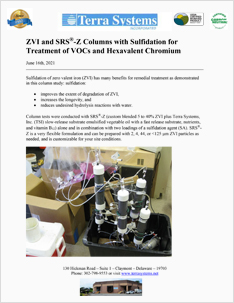
ZVI and SRS-Z Columns with Sulfidation for Treatment of VOCs and Hexavalent Chromium
Sulfidation of zero valent iron (ZVI) improves the extent of degradation of ZVI,increases the longevity, and reduces undesired hydrolysis reactions with water.
pH Buffering
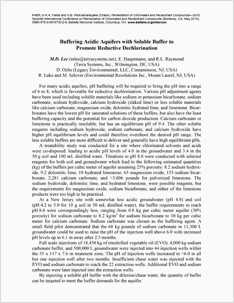
Buffering Acidic Aquifers with Soluble Buffer to Promote Reductive Dechlorination.
The groundwater pH at the site was about 4.8. Sodium carbonate was chosen as the buffering agent. A total of 52,500 pounds of SRS, 9,900 pounds of sodium carbonate, and 323,000 gallons of groundwater were injected into the 180 by 384 x 25 foot thick treatment area.
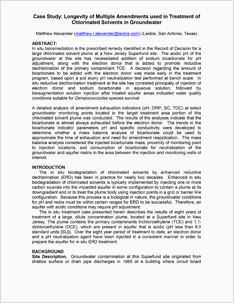
Case Study of the Biotreatment of a Dilute Chlorinated Solvent Plume in an Acidic Aerobic Aquifer.
In situ bioremediation has been used to a treat a 30-acre plume of diluted chlorinated solvents in an acidic aquifer in central New Jersey since 2010. About 1,000 L of bioaugmentation culture have been injected along with serval million gallons of emulsified vegetable oil and sodium bicarbonate.
Importance of Vitamin B12
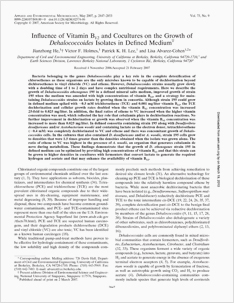
Influence of Vitamin B12 and cocultures on the growth of Dehalococcoides isolates in defined medium.
Dehalococcoides (DHE) are commonly found in mixed microbial communities withfermenters such as Desulfovibrio, Eubacterium, Acetobacterium, Citrobacter, and Clostridium. These organisms ferment a wide variety of compounds such as hexoses, lactate, pyruvate, and butyrate into H2 and acetate.
Importance of Lactate, Nutrients and Bioaugmentation
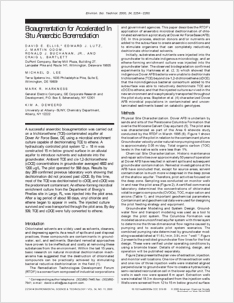
Bioaugmentation for accelerated in-situ anaerobic bioremediation.
The first successful anaerobic bioaugmentation project was carried out on a trichloroethene (TCE)-contaminated aquifer at Dover Air Force Base, DE, using a microbial enrichment culture capable of dechlorinating TCE to ethene.
View paper →
Use of statistical tools to evaluate the reductive dechlorination of high levels of TCE in microcosm studies.
A microcosm study was performed to select amendments for reductive dechlorination of dense non-aqueous phase liquid (DNAPL) levels of trichloroethylene (TCE) found at an industrial site in the United Kingdom (UK).
View paper →
Looking for More Technical Insight?
Whether you’re researching a treatment technology or preparing for your next remediation project, our technical team is here to help.